
English| EUR
Suggested for you
More currencies
Choose a language
The stretch of Alborán Sea off Marbella holds resident pods of common and bottlenose dolphins within a short run of the coast, yet sightings depend far more on wind and hour than on luck. This dolphin watching marbella spain guide sets out how the excursions work, what departure schedules look like across the season, and what conditions to read before booking.
Quick answer
Boat operators run trips from Marbella throughout the day, year-round, with the morning window of 08:00–11:00 offering the calmest sea for spotting fins. Shared excursions typically start from around 40 EUR per person. Sightings are common but never guaranteed: wildlife is wild, and a strong Levante wind can flatten visibility or cancel sailings entirely, whatever the season.
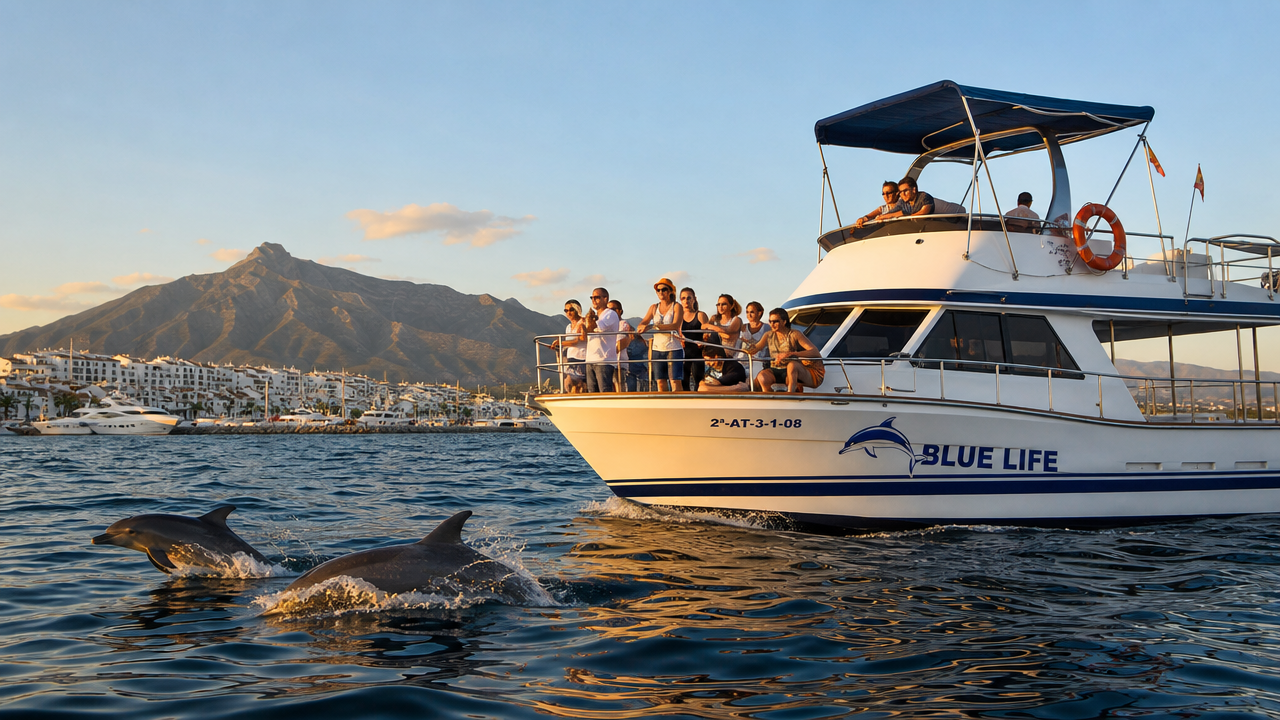
The water off Marbella is not open Mediterranean but the Alborán Sea, the narrow basin where Atlantic and Mediterranean currents collide east of Gibraltar. That collision drives a nutrient upwelling unusual for this coast, which is why common dolphins, striped dolphins and bottlenose pods feed within a few nautical miles of the shoreline rather than far offshore. Boats rarely need to travel far. Most of what visitors researching dolphin watching marbella spain will encounter is a short run parallel to the coast, La Concha mountain visible astern the whole way. The practical variable is not the animals. It is the sea state. Marbella sits between two competing wind systems: the Poniente, which pushes in from the west, and the Levante, which funnels through the Strait and can build chop within hours. Dolphin dorsal fins read as small dark interruptions on a flat surface; on a broken one they vanish. This is the single reason experienced skippers favour the early hours, before thermal heating stirs the afternoon breeze. Anyone comparing a Marbella dolphin watching tour against a Tarifa or Gibraltar equivalent should note the difference in scale — the Strait crossings target pilot whales and orca in deep water, while the Costa del Sol trips are coastal, shorter, and considerably gentler underfoot. Season shapes the odds more than most visitors expect. Late spring and early autumn bring calmer swell and thinner traffic; high summer, including this August, delivers reliable weather but a crowded stretch of water between Puerto Banús and the marina at La Bajadilla, where jet skis and charter yachts add noise that pods often move away from. Winter sailings continue and can be excellent, though cancellations for weather are more frequent. Operators along this coast generally follow the Andalusian cetacean-approach code: engines throttled at distance, no boat pursuing a pod, no more than a set number of vessels around a sighting at once. Reputable skippers will hold position and let curious animals approach the hull rather than chase them, and bow-riding — dolphins surfing the pressure wave ahead of a moving boat — is the behaviour most trips actually deliver. Understanding that constraint reframes the whole question of dolphin watching marbella spain: the trip is not a guaranteed transaction but a well-informed attempt, and the operators with the highest sighting rates are usually the ones that respect the distance rules most consistently. Check the forecast the night before, pick the earliest sailing available, and treat a blank sea as a possible outcome rather than a failure.
“Dolphin dorsal fins read as small dark interruptions on a flat surface; on a broken one they vanish.”
The best arrival window is 08:00–11:00, as morning trips generally offer the calmest sea conditions for better sighting opportunities. Planning your excursion during these hours maximizes the likelihood of stable waters and successful dolphin sightings.
—
Calm waters provide the highest visibility for spotting marine life.
Mild temperatures averaging 18-24°C
Spring weather offers comfortable conditions and consistent sightings.
Warm temperatures averaging 25-30°C
Busy maritime traffic may require earlier morning departures.
Pleasant temperatures averaging 20-26°C
Sea conditions remain favorable with fewer boats on the water.
Verdict: The optimal time for a dolphin watching excursion is during the 08:00–11:00 arrival window in either April or October.
Dolphin watching excursions in Marbella operate daily throughout the week, providing consistent opportunities for maritime observation. Vessels depart regularly to accommodate varying schedules.
Dolphin watching excursions depart from Puerto de la Bajadilla or Puerto Banús in Marbella, Spain. Visitors should confirm their specific departure port in advance to ensure they arrive at the correct location.
A-7 highway to Marbella exits
Avanza bus to Marbella Bus Station
Direct transfer to the port entrance
Check your booking confirmation carefully to distinguish between Puerto de la Bajadilla and Puerto Banús. Aim to reach the port during the 08:00–11:00 arrival window to facilitate a smooth departure.
A short round of preparation, spread from the weeks before your trip down to the hour you board, keeps a Marbella dolphin watching trip running smoothly.
Everything you need to know about dolphin watching marbella spain
When planning your visit, note that sightings depend on sea conditions and marine behavior. Dolphin watching marbella spain is a popular activity, so checking availability early helps ensure your preferred date. Always listen to the captain regarding safety protocols while on the water.
Excursions operate throughout the week. You can find availability across all seven days to suit your holiday schedule, though conditions fluctuate based on the Mediterranean weather.
The typical starting price per person for shared boat excursions is 40 EUR. Prices can vary based on the provider, so confirm the final rate when finalizing your plans through a booking partner.
Boats for dolphin watching marbella spain typically depart from either Puerto de la Bajadilla or Puerto Banús. Ensure you check your confirmation details for the exact boarding location before heading to the port.
Families often enjoy this experience as it provides an educational look at marine mammals. Be sure to bring sunscreen and hats to protect children from the Mediterranean sun during the outing.
Beyond common dolphins, visitors sometimes spot striped dolphins or even sea turtles in these coastal waters. These marine creatures are wild, so sightings are subject to nature's schedule rather than a fixed itinerary.
The best arrival window is 08:00–11:00. Morning trips generally offer the calmest sea conditions for better sighting opportunities.
Booking ahead is recommended to secure your place on a vessel. Planning your dolphin watching marbella spain trip in advance allows you to better organize your time in the city.