
English| EUR
Suggested for you
More currencies
Choose a language
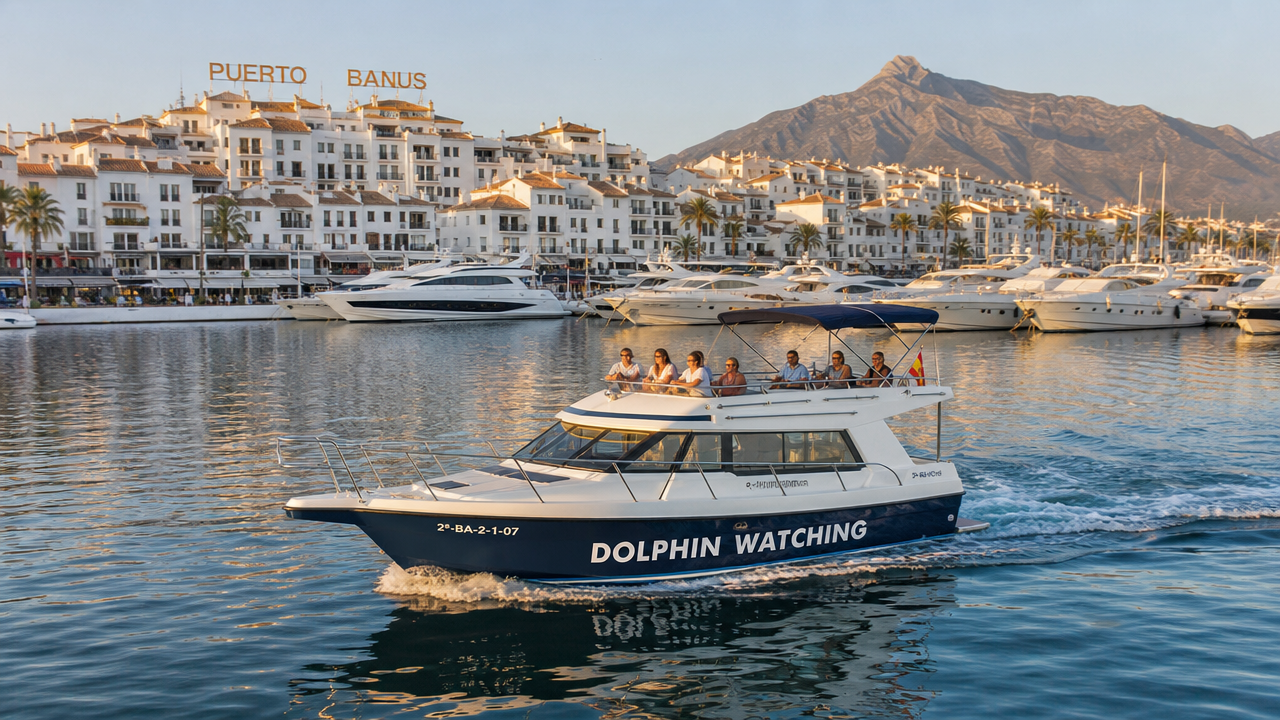
Almost every dolphin trip on this stretch of the Costa del Sol pushes off from the same marina, yet departure times, boat sizes and sea conditions vary considerably between them. This dolphin watching boat marbella guide sets out the practical frame: where you board, which hours are workable, and why the morning matters more than the month. Sightings are never guaranteed, and the honest version of that caveat is here too.
Quick answer
Boats leave from Puerto José Banús, 29660 Marbella, Málaga, Spain, with operators running between 09:00 and 21:00 seven days a week. There is no fixed entrance fee; prices vary by private operator and tour type. The recommended arrival window is 09:00–11:00, when the sea is generally calmest and dorsal fins are easiest to pick out against flat water.
The Alborán Sea, the westernmost basin of the Mediterranean, is one of the most cetacean-rich stretches of water in Europe — a consequence of the Strait of Gibraltar, where Atlantic water pours in and stirs up nutrients that feed everything from sardine shoals to pilot whales. Marbella sits on the northern edge of that system. A dolphin watching boat marbella trip is therefore not a novelty attraction bolted onto a resort coastline; it is a short run into genuinely productive water, where common dolphins, striped dolphins and bottlenose dolphins are all resident, and where sightings of them are frequent rather than freakish. What a visitor is actually dealing with is a fleet of independent operators rather than a single institution. Boats leave from Puerto José Banús, the marina at the western end of the municipality, and range from rigid inflatables carrying a dozen passengers to broader catamarans with shaded upper decks. There is no shared ticket office, no unified schedule, and no standard trip length. Some sail west toward Estepona, others hold a line parallel to the coast off Golden Mile and Puerto Deportivo de Marbella. This variety is the reason online research feels contradictory: two accounts of the same marina can describe entirely different vessels, prices and durations, and both can be accurate. Sea state governs everything. The Alborán is prone to a stiff easterly known locally as the levante, which raises a short chop that makes fins nearly impossible to distinguish from whitecaps and makes small boats uncomfortable. Poniente winds from the west tend to be gentler. Crews watch these patterns closely, and a marbella dolphin watching tour that departs on flat water will simply see more than one that departs on a ruffled surface — the animals are equally present, but the observer is not equally equipped. Cancellations for weather are common and are a sign of a careful operator, not a failing one. The useful conclusion is to treat any Costa del Sol boat excursion as a weather decision first and a booking decision second. Check the forecast the evening before, favour an early departure, and keep flexibility in the itinerary so a cancelled sailing can be moved rather than lost. Read the operator's own conditions on sighting guarantees, since some offer a free repeat trip and others do not. Approached that way, a dolphin watching boat marbella outing becomes a reasonable proposition rather than a gamble on a single fixed morning.
“The animals are equally present on a rough day; the observer is not equally equipped.”
The best arrival window for dolphin watching in Marbella is 09:00–11:00, as morning trips generally offer the calmest sea conditions for dolphin spotting. Aligning your visit with these hours minimizes surface chop and improves visibility.
—
Lower traffic on the water facilitates better spotting conditions.
Mild 18°C–22°C; stable seas
Migratory patterns make these months favorable for sightings.
Warm 25°C–30°C; calm mornings
Early departures provide respite from peak afternoon heat.
Mild 20°C–24°C; occasional wind
Sea temperatures remain warm, often extending the active season.
Verdict: The best time to visit is during weekday mornings in April, May, September, or October when sea conditions are calmest and harbor activity is reduced.
Dolphin watching departures from Puerto José Banús operate on a consistent daily schedule to facilitate your trip planning.
There is no fixed entrance fee for dolphin watching activities in Marbella. Costs are determined entirely by the private tour operators and the specific type of boat trip selected.
Verdict: While port access is free, visitors should expect to pay varying rates for boat tours depending on the operator and chosen excursion package.
Dolphin watching departures are located at Puerto José Banús, 29660 Marbella, Málaga, Spain. The port is easily accessible via the main coastal road, the A-7, or by local bus services from Marbella center.
A-7 or AP-7 motorway, follow signs for Puerto Banús
L-79 or L-78 bus lines to Puerto Banús stop
Direct service to Puerto José Banús entrance
Parking can be limited during peak hours, so plan to arrive early to locate a space in one of the public underground car parks near the port entrance. Once parked, follow signs for the marina to reach the boat departure docks.
A short list of things to sort out before your boat leaves Puerto José Banús, ordered from weeks ahead to the moment you board.
Everything you need to know about dolphin watching boat marbella
Yes, many operators welcome families and provide life jackets for children on every vessel. Watching marine life in their natural habitat can be an educational experience for travelers of all ages.
Morning trips between 09:00 and 11:00 are recommended as they generally offer the calmest sea conditions for dolphin spotting. Heading out early helps ensure a smoother ride for passengers.
There is no fixed entrance fee for these tours, as prices vary by private operator and specific tour type. Visitors should check individual listings to compare options before finalizing plans.
Every dolphin watching boat Marbella service departs from Puerto José Banús, 29660 Marbella, Málaga, Spain. This location is easily accessible by public transport or car within the local area.
Passengers should pack sunscreen, sunglasses, a hat, and a camera to capture potential sightings of cetaceans. It is also wise to bring a light jacket as temperatures can drop slightly while out at sea.
Yes, these maritime excursions operate daily from Monday to Sunday. Boats generally run their schedules between 09:00 and 21:00 to accommodate various visitor preferences.