
English| EUR
Suggested for you
More currencies
Choose a language
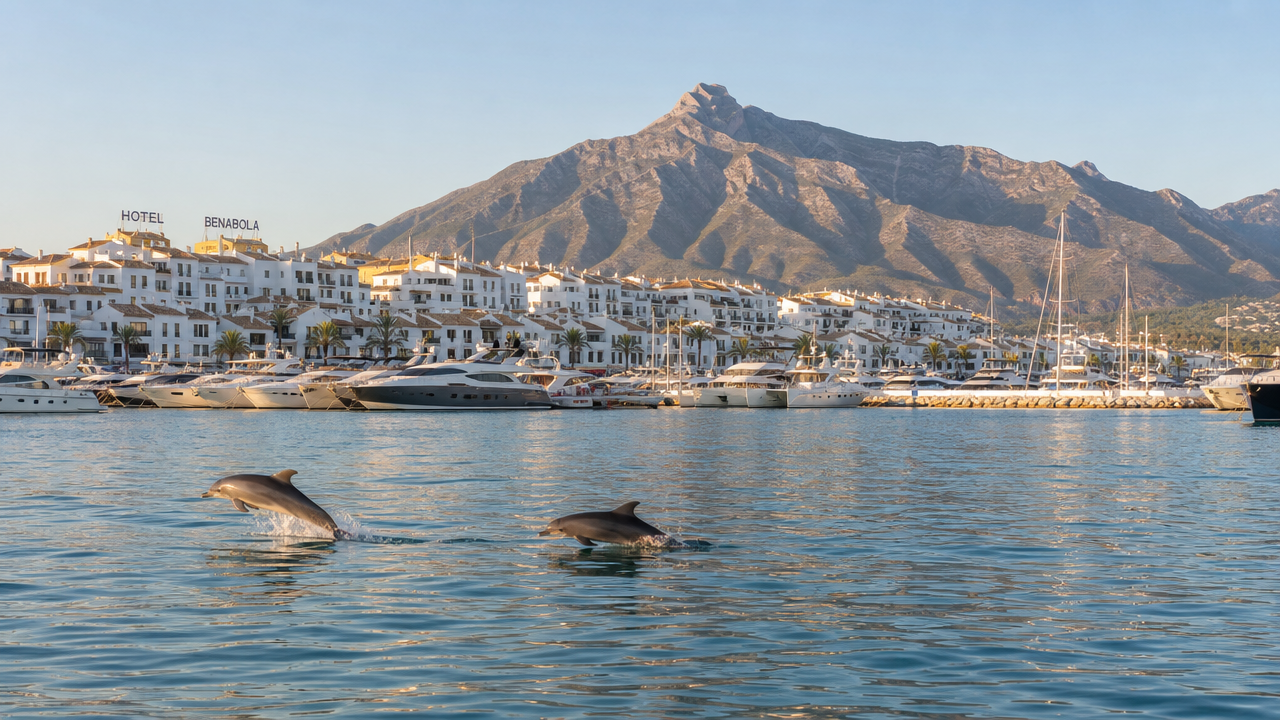
The stretch of Mediterranean between Marbella and the Strait of Gibraltar is one of the busiest cetacean corridors in Europe, and boats leave Puerto Deportivo de Marbella into it every day of the year. This page explains what actually lives out there, how reliably it appears, and what governs a good sighting.
Quick answer
Yes. Dolphins are resident year-round in Spanish waters, and boats from Puerto Deportivo de Marbella regularly encounter common, striped and bottlenose dolphins in the Alborán Sea. Group excursions start from around 72 EUR per adult. Sightings are never guaranteed — sea state matters more than season, which is why the 08:00–11:00 window is recommended.
The Alborán Sea, the western basin that Marbella faces, holds more cetacean species per square kilometre than almost anywhere else in the Mediterranean. Cold Atlantic water pushes through the Strait of Gibraltar and collides with warmer Mediterranean water, forcing nutrients upward. Sardine and anchovy shoals follow. Dolphins follow the shoals. So the honest answer to are there dolphins in Spain is not merely yes, but that this particular coastline is one of the better places in Europe to look for them. Three species dominate the Costa del Sol. Striped dolphins travel in fast, tight groups and rarely linger. Common dolphins ride bow waves and are the ones most passengers photograph. Bottlenose dolphins are larger, slower and more curious, often working close to the shelf edge a few miles out from the Sierra Blanca shoreline. Pilot whales and the occasional sperm whale move through deeper water toward Gibraltar, though these belong to longer crossings rather than a standard Marbella dolphin watching trip. What governs a sighting is not the calendar but the surface. A dorsal fin against flat water is visible at several hundred metres; the same fin in a metre of chop disappears entirely. Levante and poniente winds decide this, and both tend to build through the afternoon. That is the practical reason morning departures from the Puerto Deportivo outperform later ones — the animals are no more present at nine than at four, but the observer is far more capable. No licensed operator on this coast will promise an encounter, and any that does is misrepresenting wild animals. Spanish regulations under Royal Decree 1727/2007 govern approach distance, speed and engine use around cetaceans, so skippers hold position and let the pod decide. Rates run high in summer, considerably lower in a winter swell. Readers using this are there dolphins in Spain guide as a planning tool should treat a trip as a strong probability rather than a booked event, allow flexibility to shift days if the forecast turns, and check the dedicated timing, pricing and harbour-access sections on this site before committing to a departure.
“The animals are no more present at nine in the morning than at four in the afternoon — but the observer is far more capable.”
Wildlife spotting near Marbella is most successful during the morning hours, specifically between 08:00–11:00, when sea conditions are typically at their calmest. Planning your trip during the shoulder seasons often balances favorable weather with manageable visitor numbers.
—
The best arrival window is 08:00–11:00, as morning trips generally offer calmer seas and higher chances of spotting wildlife.
18°C to 24°C
Spring offers mild temperatures and active marine life as water temperatures begin to rise.
25°C to 30°C
Summer sees peak sea traffic, though consistent weather facilitates regular departures.
20°C to 26°C
These months provide pleasant air temperatures and quieter coastal waters for excursions.
Verdict: For the highest probability of sightings and calmest conditions, aim for weekday mornings between 08:00–11:00 during the months of April or October.
Excursions departing from the Puerto Deportivo de Marbella operate daily to accommodate dolphin watching schedules.
Dolphin watching excursions depart from the Puerto Deportivo de Marbella, located centrally along the town's coastline. The harbor is easily accessible by foot from the city center or via local transport links.
Walk south towards the seafront from Avenida Ricardo Soriano
L-79 or L-1 to Marbella Centro station
A-7 or AP-7 motorway following signs for Marbella Centro/Puerto
Direct drop-off at Puerto Deportivo de Marbella entrance
For the best experience, plan your travel to arrive within the best arrival window of 08:00–11:00. Use the main entrance of the Puerto Deportivo de Marbella to locate your specific departure point.
A dolphin-watching trip from Marbella rewards a little advance planning, so work through these steps in order from the weeks before to the morning you sail.
Everything you need to know about are there dolphins in spain
Yes, you can spot dolphins in the Mediterranean waters surrounding Marbella. Local boat excursions provide access to these marine mammals in their natural habitat as you explore the coastline. Many visitors wonder are there dolphins in Spain, and the answer is that the Costa del Sol is a prime region for these sightings. Understanding the biodiversity of the Alboran Sea helps confirm that are there dolphins in Spain to be seen near local harbors.